

Maghrib, 6:10 pm, a house in Multan. Eight-year-old Ali has been in the bathroom for four minutes. His mother calls through the door: “Did you do your elbows?” “Yes!” “Both feet?” “Yes, Ammi!” He comes out with dry elbows and one wet sock.
Tomorrow the same conversation happens again. And the day after.
Teaching wudu steps for kids has a strange shape. The steps themselves take two minutes to explain. Getting a child to do them correctly, alone, without being supervised from the doorway, can take two years. This article is about closing that gap in a week.
Why children get wudu wrong (even when they know the steps)
Ask Ali to list the steps and he will do it perfectly. Knowing is not the problem.
The problem is that wudu happens in a room where he is alone, with water running, with Maghrib about to start and a cartoon paused in the other room. Under those conditions, children do not run through a mental list. They do the parts that feel like washing (hands, face) and skip the parts that feel like extra (elbows, heels, behind the ears).
There is no list in the bathroom to remind him. So the list in his head loses to the sound of the water.
A child does not forget the steps of wudu. A child forgets them in a bathroom with the tap running and nobody watching.
Wudu steps for kids, the way they actually learn
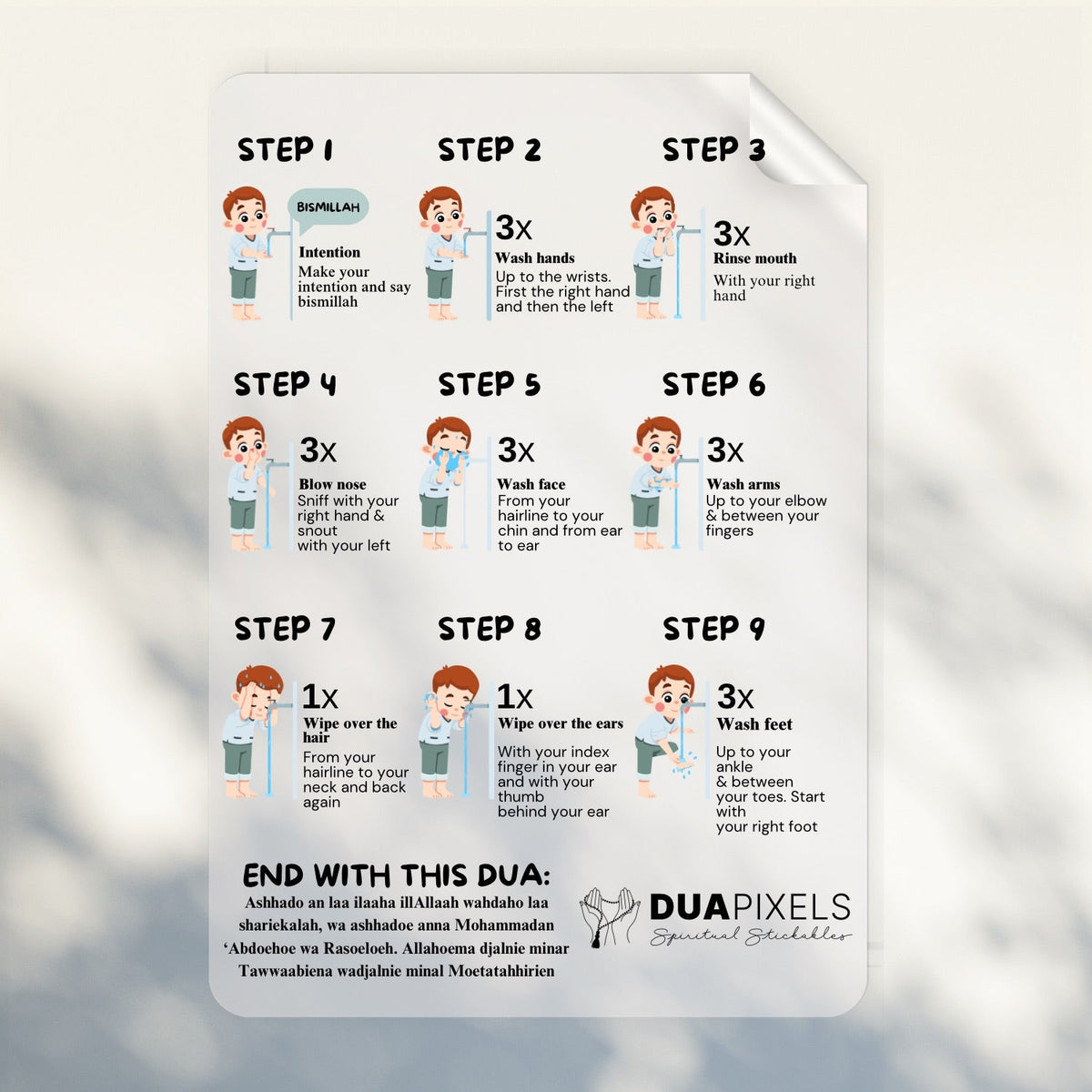
Here is the sequence most children are taught, with the parts they forget in bold:
- Make the intention and say Bismillah.
- Wash both hands to the wrists, three times.
- Rinse the mouth, three times.
- Rinse the nose, three times.
- Wash the whole face, three times, hairline to chin, ear to ear.
- Wash the right arm, then the left, three times each, all the way to and including the elbow.
- Wipe the head once with wet hands, and the ears, front and back.
- Wash the right foot, then the left, three times each, including the heels, the ankles and between the toes.
Four of those parts are named in the Quran itself, in Surah Al-Ma’idah: the face, the arms to the elbows, wiping the head, and the feet to the ankles. Tell your eight-year-old that. It changes the elbows from “Ammi’s rule” to “Allah’s instruction”, and children respond to that difference.
The 7-day method
Day 1: Put the steps where the water is
Not in a book in the bedroom. On the bathroom wall, next to the tap, at your child’s eye level when standing at the basin. Pictures, not just words, because a child mid-wudu with wet hands is not going to read a paragraph. One glance, one step.
This single change does more than the other six days combined. The list is now in the room where the list is needed. The same logic works for duas: put the reminder where the moment happens.
Day 2: Do wudu together, you first
Stand at the basin and do your own wudu slowly while your child watches and points to each step on the chart as you do it. Children love catching an adult in a mistake, so skip your elbow on purpose and see what happens.
Days 3 and 4: They lead, you follow
Now swap. Your child does wudu, you stand behind them and copy exactly what they do, including mistakes. If they skip the heels, you skip the heels, and then say “wait, what did we both miss?” and point at the chart. This feels silly. It works, because they discover the gap instead of being told about it.
Day 5: Say the step out loud
Your child does wudu alone while narrating each step aloud. “Right arm to the elbow, one, two, three.” You are outside the door, listening only. If a step is missing, wait until they come out, then ask them to find it on the chart.
Day 6: Silent, alone, checked after
No narration. They go in, do wudu, come out. You do one quick check: touch the elbow, touch the heel. Dry? Back in for that step only, not the whole wudu.
Day 7: The dua after wudu
Once the steps are solid, add the finishing piece: the short dua after wudu, on the wall beside the steps. This is the moment the whole thing stops being a chore and becomes an act of worship in your child’s mind, because it now ends the way salah begins, with words addressed to Allah.
Islam teaches us not to waste water, even during wudu. Teach your child to close the tap while rinsing the mouth and wiping the head. In a house that runs on a motor and a tank, during load-shedding, they will understand this quickly. It is also the easiest way to spot a child rushing: the tap never stops.
For the wall beside the tap
Step-by-Step Wudu Guide Wall Sticker
Every step in order with clear pictures, sized to sit beside the basin where a child mid-wudu can glance at it with wet hands.
The three mistakes almost every child makes
Dry elbows
The child washes the forearm and stops an inch short. Teach them to cup water in the left hand and pour it over the right elbow deliberately, then switch. “Pour on the bone” is the phrase that sticks.
Dry heels
Water runs over the top of the foot and never reaches the back. The Prophet (peace be upon him) warned specifically about heels left dry in wudu, and that warning is well known. Teach them to rub the heel with the hand, not just hold the foot under the tap.
Left before right
It is the sunnah to begin with the right, and children who learn it early never have to unlearn it. The chart solves this on its own if the pictures show right, then left.
What age should you start?
Most children can follow the steps with help from around five, and do them alone from seven, which is also the age at which they are encouraged to begin praying regularly. Before five, let them splash alongside you and copy. Nobody is checking a four-year-old’s elbows.
For a younger child, or a bathroom where a sticker is not practical, an acrylic wudu guide can stand on the shelf or move from one bathroom to another, which helps in a joint family with shared bathrooms.
What changes after the week
You stop standing in the doorway. That is the real result. Ali goes in, you hear the tap, you hear the dua, he comes out ready for Maghrib. Nobody asked about the elbows.
And then, once wudu is automatic, the next step opens up naturally: teaching salah itself, with the same method. Pictures where the action happens, child leads, parent follows.
Start with the wall. Put the steps beside the tap tonight.
For shared bathrooms and small hands
Wudu Steps for Kids, in Acrylic
A sturdy acrylic guide that moves with your child from basin to basin, with cash on delivery across Pakistan and free delivery over Rs 3,000.


