

Every January, the gym is full. By the first week of March, you can get any machine you want.
The people who disappeared did not run out of motivation. They had plenty on day one. What they ran out of was evidence. Three weeks in, they looked in the mirror, saw no change, and had nothing else to look at. So they stopped.
The people who are still there in March have one thing the others don’t: a record. Somewhere, on a wall or in a notebook, they can see that they have shown up 14 times. And 14 ticks is very hard to abandon.
Why motivation is the wrong thing to chase
Motivation is a feeling. It arrives after a good night’s sleep and leaves after a long day at work. Building a fitness routine on motivation is like building a house on weather.
What actually keeps people training is much less exciting: a plan that tells you what to do before you have to decide, and a tracker that shows you it is working before your body does.
Your body takes six to eight weeks to show visible change. Your planner shows change on day two. That gap is where most people quit, and a workout planner is the bridge across it.
The two jobs of a workout planner
Job 1: Remove the decision
The hardest part of a workout is not the workout. It is the ten minutes before, standing in your room, negotiating with yourself about whether today counts. Should I do legs? Did I do legs yesterday? Maybe I’ll just walk.
A planner ends the negotiation. Monday says “Upper body, 30 min”. You do not decide. You read, and you go. Decisions cost willpower. Reading does not.
Job 2: Make progress visible
Every tick on the wall is a small, physical, undeniable “I did it”. A row of ticks becomes a streak. A streak becomes something you protect. You will do a 15-minute workout you did not feel like doing just to avoid breaking a 12-day chain. That is not discipline. That is design.
You cannot see muscle grow in a week. You can see twelve ticks. Track the ticks and the muscle follows.
How to plan a week of workouts you will actually do
Start with your real week, not your ideal one
Look at your actual schedule. Work hours, commute, family, Jumu’ah, the evenings you are always exhausted. Find three or four slots that exist in reality. Three honest sessions beat six imaginary ones.
Write the session, not just “gym”
“Gym” is a location. “Push: bench, shoulder press, triceps, 30 min” is a plan. The more specific the line on your planner, the less thinking you do at 6am.
Plan rest like it is a workout
Write “Rest” on the days off. It changes rest from “I skipped” to “I followed the plan”. Guilt-free rest days are the reason people are still training in month four.
Set a minimum version
Next to each session, write the smallest acceptable version. “30 min run” becomes “or 10 min walk”. On bad days you do the minimum and still earn the tick. The chain survives. The habit survives.
Do not write your weight on the planner every day. It will ruin your week for reasons that have nothing to do with your effort. Track what you control: sessions done, water, steps, sleep. Weigh yourself once a week, same day, same time, and write it in the notes.

Made for the streak
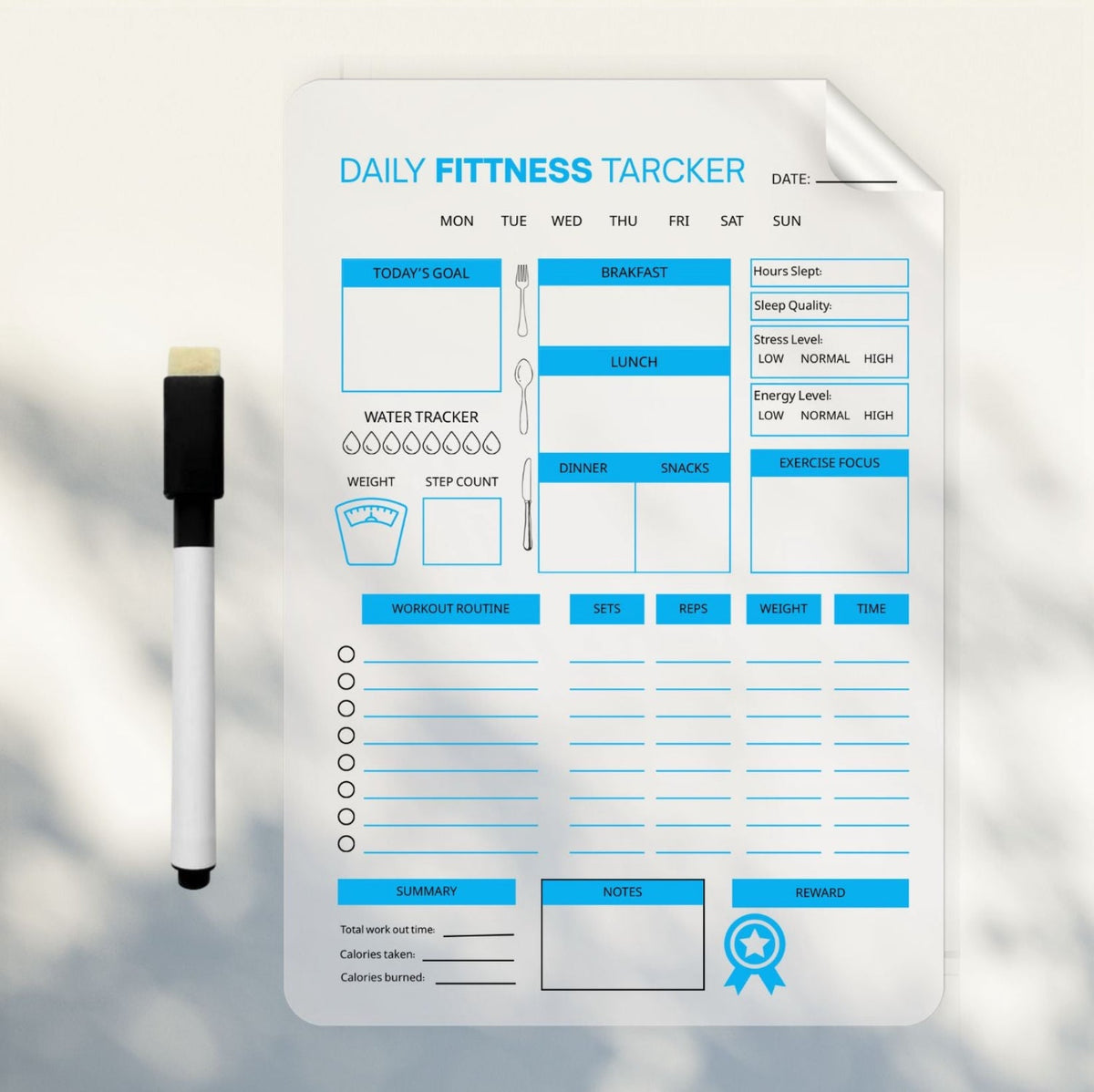
Daily Fitness Tracker Planner Sticker
Workouts, water, steps and sleep on one reusable wall sheet. Tick it every night, wipe it every week.
What to track (keep it to four things)
Trackers fail when they ask for too much. Choose four lines per day and ignore everything else for the first month:
- Workout done? A tick, a cross, or an M for the minimum version.
- Water. Glasses or bottles, however you count it.
- Steps or movement. Especially on rest days.
- Sleep hours. The one most people ignore and the one that quietly decides everything else.
After a month you will see patterns you could never feel: that you skip Thursdays, that you sleep badly after late workouts, that water drops when work gets busy. Patterns are fixable. Feelings are not.
Why the tracker belongs on a wall
A fitness app is private, which sounds nice until you realise that private also means ignorable. Nobody sees you skip. Nobody sees the streak.
A tracker on the bedroom or hallway wall is public to the only audience that matters: you, every time you walk past, and the people who live with you. A spouse who sees your 10-day streak will nudge you on day 11. A child who sees you tick off a workout learns something no lecture can teach.
It is also the first thing you see when you wake up and the last thing before you sleep. There is no better place for a plan you want to keep.
The March test
Here is how you know this works. Come March, when the gym empties out, you will not be deciding whether to go. You will be looking at a wall with ten weeks of ticks on it and wondering what else you are capable of.
Stop waiting for motivation. Put the plan on the wall, do the minimum on bad days, and let the ticks do the convincing.
Week one starts today
Plan the sessions. Track the ticks. Keep the chain.
Fitness trackers and daily planners from Dua Pixels, with cash on delivery across Pakistan.


